The Carlsbad Play
Phase 1 validates the chemistry on the Shakopee floor. Phase 4 closes the loop: vertical integration into the only feedstock route that turns waste salt water into the lowest-carbon stationary storage on Earth.
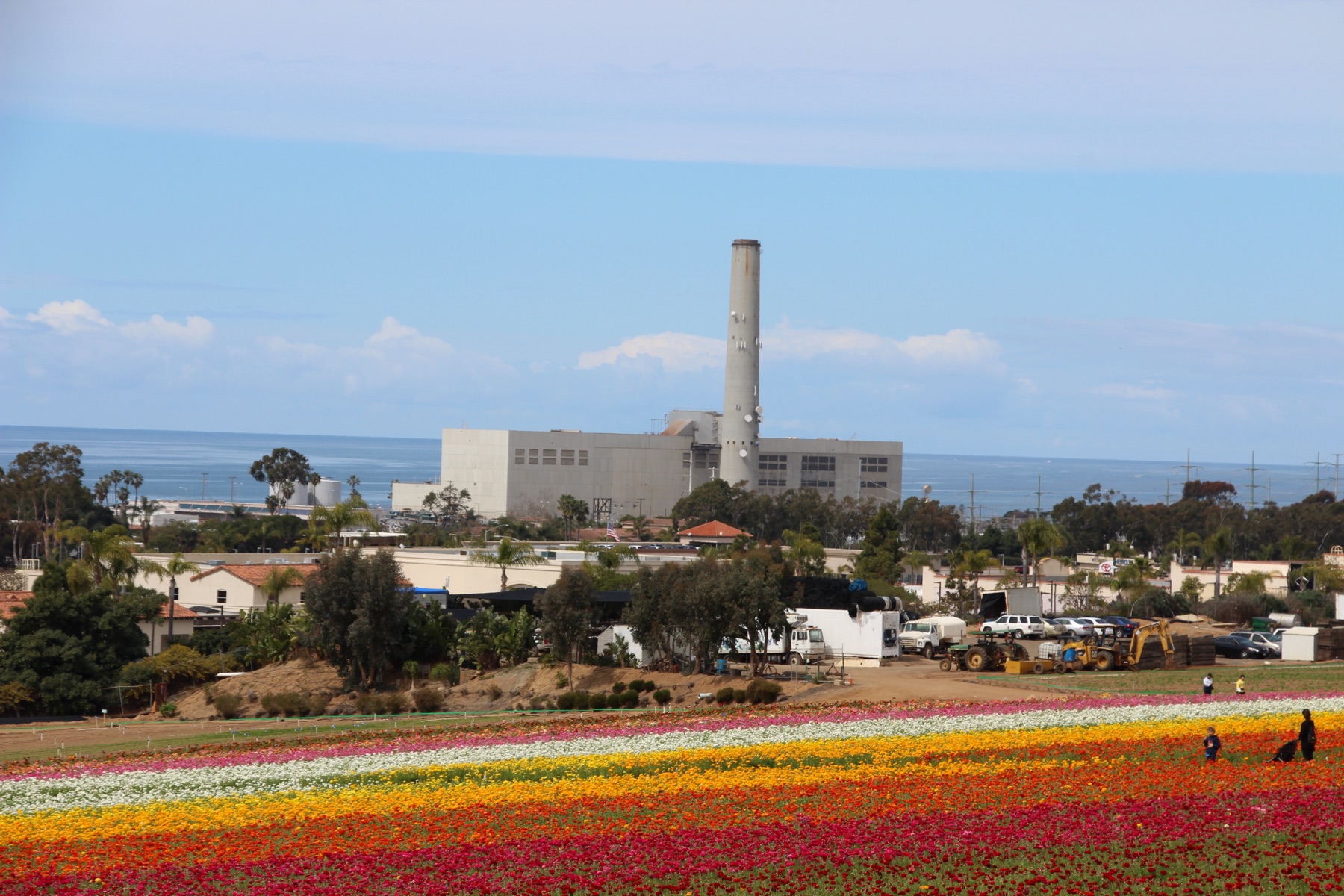
Forty-nine truckloads of magnesium are pumped back into the Pacific Ocean every single day.
The Claude “Bud” Lewis Carlsbad Desalination Plant in Carlsbad, California, the largest in North America, operates 50 million gallons per day of reverse osmosis. Its reject brine carries ~2.6 g/L of dissolved Mg2+. That is ~492 metric tons of magnesium, about 49 standard truckloads, discharged unrecovered to the Pacific Ocean every twenty-four hours, year-round, since 2015. The atoms are there. Nobody has yet built the plant to catch them. At full recovery a single Carlsbad recovery train yields ~180,000 t Mg/yr, enough MgCl2 feedstock to supply the entire projected North American aqueous-Mg BESS market through 2035 with multiples of headroom. That is a vertically-integrated feedstock position no LFP producer has ever held (they buy lithium from Albemarle/Ganfeng at commodity spot) and one no competitor can catch by writing a purchase order. The moat is the pipe from the ocean, wherever a brine gate fee, a discharge limit, or a co-located plant pays to concentrate what comes out of it. Standard Oil owned the refineries; TSMC owns the fabs; on this chemistry Emerson would own the salt.
The whale is more than magnesium. That reject stream carries ~150 t/day Ca2+ alongside the 492 t/day Mg2+, the two divalents at seawater’s natural ~3:1 ratio. Chen 2026 ran each of them as its own cell, saturated MgCl2 in one and saturated CaCl2 in the other, and both went 120,000 cycles; Chen never ran the blend. That blend is Phase 1’s ratio-series bet, and this Phase-4 frontier hinges on it: if the mixture keeps both endpoints’ life, the desal plant does the Mg/Ca mixing for free (after the standard monovalent cleanup Track B already specs), and the two divalents become a productive couple rather than chemical twins to be separated. The divalent separation step, whatever it costs in the incumbent chain, is skipped. What’s left is rejecting the brine’s monovalents (Na+/K+, the actual site-blocking poisons per the selectivity sequence) and Ba2+/Sr2+, plus one anion the ICP panel does not see: bromide. Reject brine carries ~130 mg/L Br−, and with E°(Br2/Br−) at +1.09 V vs SHE it oxidizes before chloride at the cathode’s top of charge, so Track B has to strip it and verify by ion chromatography (anions) and TOC; ICP alone misses it. All of that is front-end Track B chemistry the pilot proves in Phase 1. A blend that holds Chen’s two endpoints, fed by already-mixed brine, is what would turn “unrecovered discharge” into battery-grade electrolyte on demand. Skipping the divalent separation is the frontier; the monovalent cleanup is table stakes. The feedstock still has a price: reject brine is ~0.1 M Mg, concentrating it to a saturated electrolyte is ~50× by evaporation, roughly 3–7 kWh-electric per kg MgCl2 with MVR/MED, or $150–350 per tonne at $0.05/kWh before capex, and the brucite route (lime or NaOH, then HCl) runs roughly $250–700 per tonne in reagents; solar-pond bischofite (Intrepid-style, ~$300/t) is therefore the cost floor, and desal feedstock becomes cheaper only where a brine gate fee, a discharge limit, or a co-located plant pays for the concentration. The frontier has one drawn edge: concentrated Mg/Ca chloride can precipitate tachyhydrite (CaCl2·2MgCl2·12H2O), so the working electrolyte lives inside a composition-and-temperature envelope that keeps both divalents in solution, a recipe constraint Phase 1’s ratio series maps rather than a new unit operation. A blend held below saturation to stay clear of that boundary gives back part of the water-activity benefit, which the ratio series also measures. Neither cation is orphaned; Mg is the anchor and the whale’s harvest.
This page lays out what catching them would look like, what the carbon math says, what California pays you to do it, and where the credible gaps sit. The Carlsbad play is gated on Phase 1–3 success; if the chemistry fails its 12-month kill-gate, none of this matters. If it lands, the western-region beachhead becomes the second-largest decision in the program.
The Encina Power Station: ninety-five brownfield acres, already industrial, directly adjacent to the brine stream.
The Carlsbad desal plant occupies six acres of the historic 100-acre Encina Power Station property on the south shore of Agua Hedionda Lagoon, fronting Carlsbad Boulevard. NRG decommissioned and demolished the Encina natural-gas peaker plant between 2018 and 2022. The remaining ~95 acres are brownfield: already industrially zoned, already grid-connected, already routed past Poseidon Water’s brine outfall, with City of Carlsbad redevelopment planning underway for mixed industrial / recreational reuse.
A 20–40 acre rejection-and-concentration train + Mg/Ca chloride purification footprint fits with room to spare. The brine outfall pipe runs through the parcel; the tap-off engineering is trivial compared to greenfield permitting from scratch.
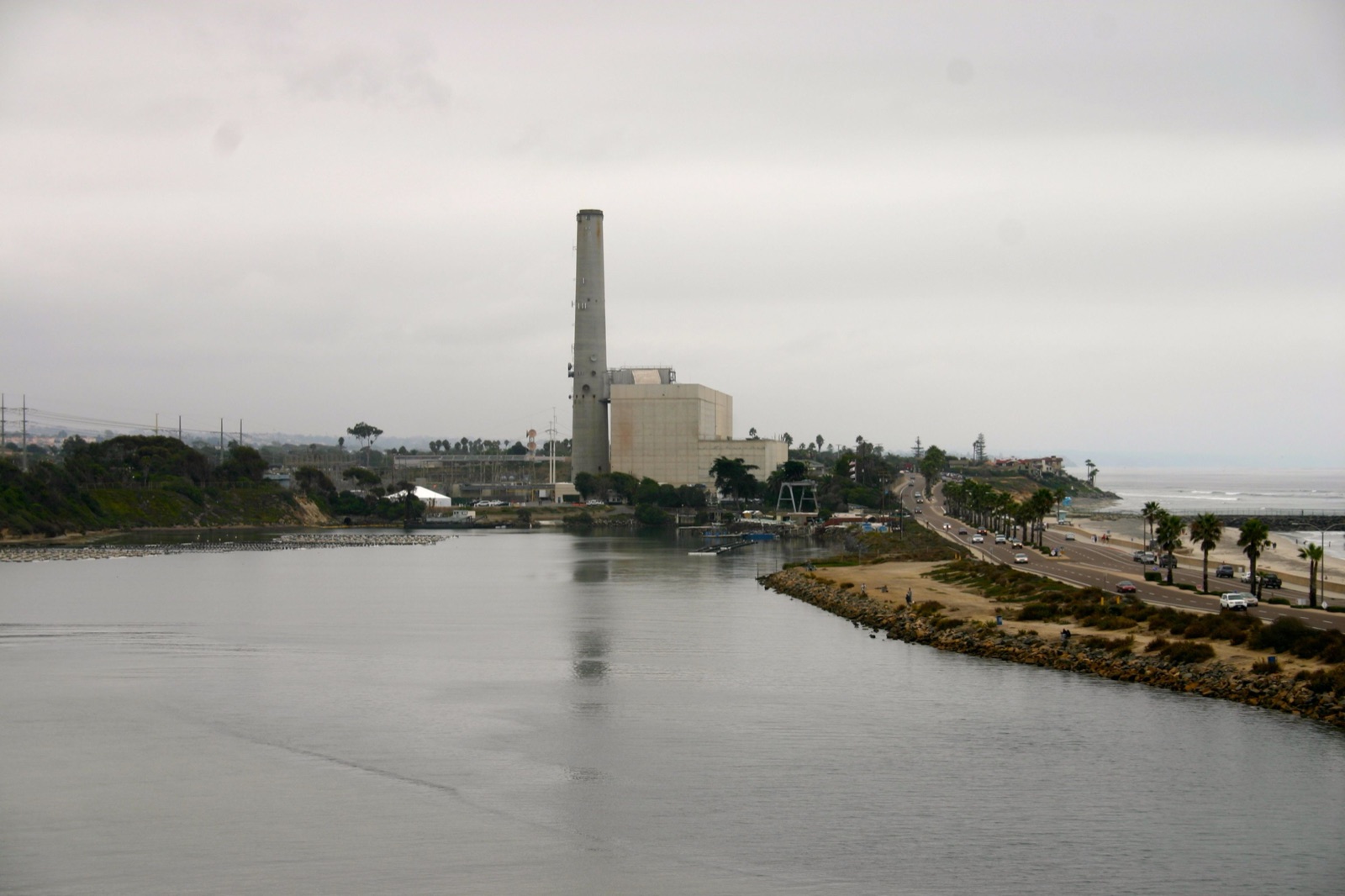
Known. The Encina Power Station operated on ~95 acres of the historic 100-acre Encina site fronting Carlsbad Boulevard (33°08'41"N 117°20'26"W). NRG decommissioned the plant Dec 11, 2018 under the original 2014 CPUC settlement that required demolition within three years of retirement; demolition completed 2020–2022. The Carlsbad Desalination Plant occupies ~6 acres of the same historic parcel. NRG’s replacement, the 530 MW Carlsbad Energy Center peaker, is on an adjacent smaller footprint.
Not yet verified in public web sources. Current ownership of the ~95-acre balance parcel after demolition. Wikipedia’s article still lists NRG; recent (2023–2026) news searches return no coverage of a sale, subdivision, or public redevelopment plan. City of Carlsbad’s planning division does not publicly expose parcel-level project status through crawlable channels. What’s needed: (a) direct RFI to NRG West Property Development, (b) San Diego County Assessor parcel query (APN 210-010-xx family, human-only interface), (c) City of Carlsbad Planning Division ADR request, (d) NRG Q3–Q4 2025 SEC 10-K review for divestiture disclosure. All of it is Phase 2 diligence.
How much land do we actually need? A 20–40 acre rejection-and-concentration train + Mg/Ca chloride purification footprint fits the 12,000 t/yr announcement paragraph. If the full 95 acres is unavailable, a 25-acre sub-parcel is enough, and the desal plant is only 6 acres, so there is a lot of remaining ground even if a portion has been optioned for another use. Downside risk on a partial-availability outcome: the plant works but the future 25 GWh/yr regional BESS-integration campus described in Section 06 would need a second site.
Why a prime coastal parcel has not been swept up by private equity.
The gut question on a 95-acre San Diego County oceanfront brownfield: Why is it still sitting there in 2026? Comparable coastal industrial acres trade at $3–5M per acre in the San Diego market; the raw land is theoretically worth $200–450M. But four hard constraints keep it off the private-equity table, each of which is a headwind for a housing developer and a tailwind for a battery-feedstock chemistry plant that co-locates with the neighboring desalination plant.
The synthesis. Every constraint that keeps a private-equity real-estate fund out is a constraint an industrial chemistry operator either accepts as normal or converts into an argument. The exact same feature stack that reads “liability” to a housing REIT reads “plug-and-play industrial site” to a battery-feedstock plant. That’s why the parcel is available. That’s why the deal is winnable at market-clearing land prices rather than trophy-coastal prices.
If Emerson establishes the first Mg-from-desal-brine recovery plant in North America on a former thermal-generation coastal parcel, California’s political stack lines up. Newsom-administration priorities: (a) clean-energy manufacturing reshoring to counter Chinese battery dominance, (b) coastal-industrial modernization aligned with SB 100 net-zero grid, (c) named domestic critical-minerals producers to satisfy IRA §45X domestic-content language. San Diego County + City of Carlsbad political stack: high-paying industrial jobs replacing a demolished polluting plant, tax-base growth on remediated land, direct environmental win (recovering minerals that were being discharged).
The realistic incentive envelope for a plant of this size and shape (see §05 for the itemized capex offset), combined with a governor whose office actively brokered Tesla, Rivian, and Redwood Materials incentive packages, means the "Elon-style subsidy" playbook is not out of reach. What it takes: a named General Counsel who can navigate GO-Biz, IBank, CEC, and CARB in parallel; a lobby-of-record with existing Sacramento relationships (not novel); and a governor visit at ribbon-cutting. Emerson has done this before: different state, same posture. Cluj Romania (2003), Iowa (2019) both landed governor visits.
Reasonable Phase 2–3 subsidy target: $75–150M of the $250–400M all-in capex, backstopped by §45X annuity through Year 5. Short of Musk-scale ($5-15B Tesla-Nevada), but Redwood Materials-scale ($100M CEC + IRA credits was Redwood’s Nevada announcement in 2022). Precedent is real.
Vertical integration is one new plant on top of one existing skill.
Battery-grade MgCl2 from raw seawater brine takes three industrial steps. Emerson already does steps 2 and 3 on the existing DeltaV + Rosemount instrumentation stack; that’s what Phase 1’s Track B purification process development validates. The only new build for Phase 4 is step 1: the bulk separation from brine.
| Step | What it does | Today (Intrepid path) | Phase 4 (Carlsbad path) |
|---|---|---|---|
| 1 · Bulk separation | Reject Na, K, sulfate, Ba/Sr, and Br from the bulk solution; Mg and Ca stay together as the working pair | The sun (Intrepid NM evaporation ponds) | Emerson: new selective rejection + concentration train on the Encina parcel (nanofiltration and sulfate/Ba-Sr/Br removal ahead of MVR or MED concentration). Mg and Ca travel together through the train as the working pair; brucite precipitation, if used at all, is the Mg-only fallback route. |
| 2 · Conversion | Concentrate the cleaned Mg/Ca chloride stream and crystallize it as a mixed chloride salt; Mg(OH)2 + HCl → MgCl2 (bischofite) only on the Mg-only fallback route | Skipped; Intrepid’s product is already MgCl2 | Emerson on existing DeltaV process control |
| 3 · Polish purification | Industrial-grade → battery-grade ≥99.9% | Emerson on Track B (Phase 1 deliverable) | Same Track B stack, plug-compatible |
This is why the sequencing matters. Phase 1 builds the polish step. Phase 4 builds the brine-recovery front-end and bolts it onto the polish step we have already mastered. Building the rejection and concentration train before proving Track B would be capex flying blind. Building Track B without a Phase 4 horizon is settling for forever-tied to NM solar evaporation. Doing both, in sequence, is the play.
"Carbon-negative" is defensible per delivered kWh under five conditions. It is not defensible per kg MgCl2, and saying otherwise is greenwashing.
The Phase 4 carbon math splits into two denominators that point in opposite directions. The narrative here uses both.
Per kg MgCl2: production from desal brine is genuinely worse than NM solar evaporation. The sun pre-sorts magnesium for free in Carlsbad NM’s evaporation ponds; doing it with NaOH at sea level burns real carbon (NaOH carries ~0.7–1.5 kg CO2-eq per kg upstream). Best production-LCA estimate under CA 2030 grid intensity (~95 g CO2/kWh per LBL projections): ~1.97 kg CO2-eq per kg MgCl2 (realistic case, grid power) or ~0.90 (best case, on-site solar + waste heat from RO). Compared to Intrepid’s ~0.1–0.25 modeled estimate, that’s 4–20× worse.
Per delivered kWh of stationary storage: the picture inverts. One kg of MgCl2 becomes ~3.3 kg of finished cell mass. At cell-level 20–30 Wh/kg (Chen et al.’s 48.3 Wh/kg for the CaCl2 cell, 40.8 for the MgCl2 cell, on the paper’s basis of anode + cathode + electrolyte mass at 1.2 and 1.1 V average discharge, derated for casing, current collectors, and separator: the same derating the FAQ’s energy-density card walks through) that delivers ~420–1,980 kWh across the cell life at the site’s canonical derated band (8,000–25,000 cycles × 80% DoD). The realistic-case 1.97 kg CO2-eq production debit, spread across that delivered energy, works out to ~1–4.7 g CO2-eq per kWh delivered, against LFP grid stationary at 50–100 g/kWh (Dai et al. / Argonne 2019, Crenna et al. 2021). One boundary caveat sits on that pairing: the LFP 50–100 g figure is a full cradle-to-delivered LCA, while the aqueous 1–4.7 g figure covers feedstock and electrolyte only, so the like-for-like ratio is smaller than the headline until the Phase 2 LCA closes the boundary. That is the claim. The thesis bound, if Chen’s 120,000 cycles held at C/4, would be ~6,300–9,500 kWh and ~0.21–0.31 g/kWh; we quote it as a bound only.
That’s the load-bearing comparison. The cycle-life advantage of aqueous Mg/Ca-ion turns a per-kg production penalty into a per-delivered-kWh win of roughly 10–100× on the feedstock-production debit alone, on the numbers we ourselves cite for cell-level performance; whole-cell to whole-cell, once the Phase 2 LCA is in, the ratio will be smaller. (A narrower electrode-only accounting would push it higher; we don’t lead with it because the customer buys cells and skids rather than electrodes.) This figure counts only the MgCl2 production debit; the proposal’s Claim 7 figure of 8–30 g CO2-eq/kWh draws a wider boundary that adds cell manufacturing, casing, and balance of system, which is why the two numbers differ and both are right for what they count. The chemistry choice carries the carbon story whether the feedstock comes from NM or Carlsbad. Co-location adds capacity to the story; the headline was already there.
So the headline this page can defend today reads: “the lowest-carbon stationary storage on Earth, with a credible engineering path to net-negative per delivered kWh under California 2030 grid conditions.” “Carbon-negative” waits on the five conditions above. That distinction will matter under post-2028 hyperscaler procurement frameworks that score lifetime kgCO2-eq per delivered kWh rather than per kg of input. Microsoft, Google, and Meta read carefully.
California pays a substantial fraction of the capex if the plant gets built.
A $50–200M capex Phase 4 plant with 50–200 FTEs and ~12 kt/yr output at the announced plant scope (10–50 kt/yr as it scales toward the stream’s ~180 kt/yr) sits squarely in the eligibility envelope of every major federal + California incentive program for clean-energy manufacturing. The stack as of mid-2026:
| Layer | Realistic magnitude | Political risk |
|---|---|---|
| §45X Advanced Manufacturing Production Credit (federal) Survived OBBBA; battery 45X explicitly retained |
$5–8M / yr × 5 yrs | Low |
| DOE Battery Materials Processing Grant $500M program, $50–100M per award, 50% cost share |
$50–100M one-time | Medium; admin priority shifts |
| California Competes Tax Credit $922.7M FY25-26 pool, $20M max single award; Peak Energy + MP Materials precedent |
$10–20M over 5 yrs | Very low; bipartisan in CA |
| CA Manufacturing Sales-Tax Partial Exemption 3.9375% off qualifying equipment, automatic |
$2–6M one-time | None |
| CEC Long-Duration Energy Storage Program Currently no open NOFO; Pacific Steel zinc-hybrid precedent |
$10–25M one-time (if reopens) | Medium |
| CARB Low-Carbon Fuel Standard / voluntary carbon market | Speculative; methodology pathway not yet defined | High |
Realistic total stack: ~$100–200M of capex offset over five years, covering roughly 40–80% of the build depending on which categories convert. The biggest single lever is the DOE Battery Materials Processing grant; the most reliable is §45X. The catch on §45X: OBBBA added a “prohibited foreign entity” disqualifier: any Chinese-sourced reagents, equipment, or financing in the BOM risks the entire credit. A US-domestic BOM is the deal.
Emerson has no manufacturing footprint in southern California today. Phase 4 changes that.
Public-record search confirms no verified Emerson Electric manufacturing site within 200 miles of Carlsbad CA: no Aspentech, NI, Rosemount, Afag, or Ovation Green. The western US footprint is corporate offices and Bay-Area-adjacent operations; the closest meaningful manufacturing is Austin TX (ex-NI). A Carlsbad CA Phase 4 plant is therefore greenfield.
That cuts two ways. The capex is bigger (no shared infrastructure, no existing supply-chain relationships). The political story is stronger (“Emerson establishes new domestic manufacturing footprint in San Diego County, 50–200 jobs, the first Mg-from-desal-brine recovery plant in North America” writes itself). The City of Carlsbad business-development office, the State of California GoBiz program, and the Brookfield Infrastructure parent of Poseidon Water are all natural partners on a story that fits each of their books.
Routing into California decision-makers from inside Emerson lands cleanly on Bob Yeager (President, Power & Water Solutions; owns the BESS + grid-tie story for the West Coast deployments this plant feeds) and Rodolphe El Khoury (VP North America Operations; has built manufacturing in Romania, Dubai, Saudi Arabia, knows the offshore-to-domestic supply-chain transition cold). Both are already on the proposal’s champion list for Phase 1.
The press release that would go out if every gate lands.
That paragraph is the dream, with nothing hidden. The two unsigned items: (a) Poseidon Water reject-brine offtake MOU, and (b) Encina parcel lease or option. Both require Phase 2-onwards relationship-building. Both are credible. Neither is shippable today.
Water is California’s defining fight. This is Emerson’s way in.
A century of California water history is a chain of unequal deals: the Owens Valley aqueduct that emptied a lake to fill Los Angeles, the Colorado River Compact that promised more water than the river carried, the Delta pumps that killed the salmon runs, the almond groves in a desert. The story reads on-screen as Chinatown and L.A. Confidential; on the ground it is fifty million people, one warming grid, and a shrinking margin. Every large California water story of the last hundred years is a story of taking. A Carlsbad brine-recovery plant would be a story of giving back: recovering a resource that has been discharged unrecovered to the Pacific since 2015, and turning it into a battery that helps run the desalination plant that produced it. That distinction is the political story worth telling.
Who Emerson brings to the table
Emerson can and should hold the majority equity + operational control. Four partner-of-record slots that make the deal easier to clinch:
- Brookfield Infrastructure Partners (parent of Poseidon Water): contractual offtake partner for the reject brine under a long-term feedstock supply agreement, with no equity. Brookfield has the sophistication to structure a tenant-tolling arrangement.
- Redwood Materials or a peer critical-minerals recycler: joint venture for the downstream sale of purified MgCl2 into other domestic battery supply chains. Optional; unlocks §45X across both nameplates.
- SDG&E / Sempra: the utility side of the story. Provides the substation interconnect for the on-site solar PPA that hits condition #1 of the net-negative case, and the buyer of the first Californian aqueous-Mg BESS pilot for grid services.
- Agua Hedionda Lagoon Foundation: the community NGO already stewarding the water body next door. A public-benefit partnership: a percentage of production revenue funds tidewater-goby habitat restoration and lagoon monitoring. Removes CCC opposition; converts the environmental community from headwind into tailwind.
Who pays the tax burden
The property is county-assessed separately from Poseidon’s desalination plant; each occupies a distinct parcel with its own APN. Emerson’s 20–40 acre sub-parcel would carry its own property tax obligation (~$1.5–3M/yr at San Diego industrial assessment rates), fully deductible against federal income and offset partially by California’s Manufacturing Sales-Tax Partial Exemption on qualifying equipment.
California funding stack itemized in §05 covers ~$100–200M of a $250–400M all-in capex, roughly 30–60% depending on which programs convert. Emerson bears the balance and holds the equity. This is a “California pays a substantial fraction, Emerson owns the plant” deal.
What we do for the community
Four commitments that would make the CCC hearing land, the county Board of Supervisors vote unanimous, and the residential neighborhoods on the other side of Carlsbad Boulevard supportive rather than hostile:
- Community Benefits Agreement with the City of Carlsbad: 40% local hire for construction, 25% for permanent operations, prevailing wage on all trades, Project Labor Agreement covering the build.
- Lagoon Stewardship Fund: 0.5–1.0% of gross production revenue earmarked for Agua Hedionda Foundation habitat restoration and monitoring, indexed annually. Direct offset to the ecological rationale a CCC skeptic would raise.
- Emerson Shakopee apprenticeship model transferred to Carlsbad: 15 apprentice slots per year with San Diego Community College District, pipeline into permanent process-tech jobs. This is philanthropy that also solves our own workforce problem.
- Discovery Center partnership: fund the “Where Salt Becomes Storage” permanent exhibit inside the Agua Hedionda Discovery Center; the 3rd-grade Environmental Stewardship program adds a curriculum module on the chemistry happening a mile up the road. Kids grow up thinking Emerson.
The California water story of the last century was written by taking. Owens Valley emptied to fill LA. Colorado River overpromised. Central Valley aquifers dropped 40+ feet in living memory. Delta smelts extinct in the wild. Chinatown and L.A. Confidential and Cadillac Desert all named what that pattern felt like from the ground.
A Carlsbad brine-recovery plant, done right, is the reverse move: recovering a resource that has been dumped unrecovered for a decade, producing a battery that stores the sun to run the AC that keeps a Central Valley home cool during a heat dome without burning gas or gasoline, and funding the restoration of an endangered fish habitat as a term of the operating license. Emerson builds a plant, and Emerson helps turn the page.
That is a philanthropic-and-industrial story a Group President can carry into a Newsom-administration meeting, a CalMatters op-ed, a shareholder letter, and a recruiting deck simultaneously. It is the story a company that owned Fisher Controls before Fisher owned itself, that put Rosemount sensors on the Apollo lunar module, and that is now 133 years old, is uniquely positioned to tell. The plant makes the battery. The story makes the plant possible.
Nothing, which is the point.
The Carlsbad play is a 2028–2030 horizon. Phase 1 sources from Intrepid Potash NM as planned: one polish step, ~$300/ton industrial grade, lowest production carbon, Pecos River stewardship language in the Phase 2 supplier agreement, kg-scale procurement invisible to the watershed. Phase 1.5 and Phase 2 build the integration prototype skid on that supply. Phase 3 secures the first commercial demo. Only after Phase 3 success does Phase 4 capex commit.
This page asks for no Phase 4 capital. It exists to name the long game out loud so that:
- Reviewers see that the program understands its own ambition trajectory beyond the next 12 months
- The Phase 1 architecture (especially Track B, the purification stack) is built compatible with whatever upstream feedstock arrives in Phase 4, with no rework and no thrown-away skids
- Champions like Yeager, El Khoury, and Train have a five-year story to carry upward as well as a 12-month one
- If a sophisticated reviewer asks "where does this go in ten years?" the answer is a single PDF
Phase 1 builds the polish step. Phase 4 builds the brine-recovery front-end and bolts it on. The chemistry is published. The brownfield is sitting empty in Carlsbad. Forty-nine truckloads of magnesium go past it every day.
Five things this page does not yet have an answer for.
No Poseidon Water MOU exists. Carlsbad CA brine-recovery partnership is uncharted; Brookfield Infrastructure has not publicly signaled openness. First step: Phase 2 RFI through Bob Yeager’s existing relationships in CA grid.
No Encina parcel option exists. NRG owned the original power-station site through demolition (2018–2022); current ownership and City of Carlsbad redevelopment plan must be verified before the 28-acre footprint can be claimed at the level the announcement paragraph uses.
No supplier-published EPDs on Nedmag or Intrepid carbon intensity yet. The per-kg numbers everywhere on this page are third-party modeling estimates; supplier outreach is scoped in the proposal’s supply-chain section and a brief at briefs/2026-06-18_supplier_lca_outreach_drafts.md.
No CARB LCFS pathway exists today for "battery feedstock recovered from desal waste brine." A petition pathway is theoretically open but is an 18–36 month CARB process with no guarantee of approval. The Phase 4 carbon-credit story is a reach.
No grants + policy FTE is scoped in Phase 1. Converting the federal + CA incentive stack requires ~2 FTE of grants-writing + policy-mapping capacity not currently on the Phase 1 roster. Phase 2 hire.
The disclosure is part of the credibility. The chemistry is published; the long game is plausible; the gaps are nameable. That’s the right posture for a 12-month ask that opens a ten-year option.
Phase 4 builds the brine-recovery front-end and bolts it on.
The brownfield is sitting empty. The atoms are already flowing.